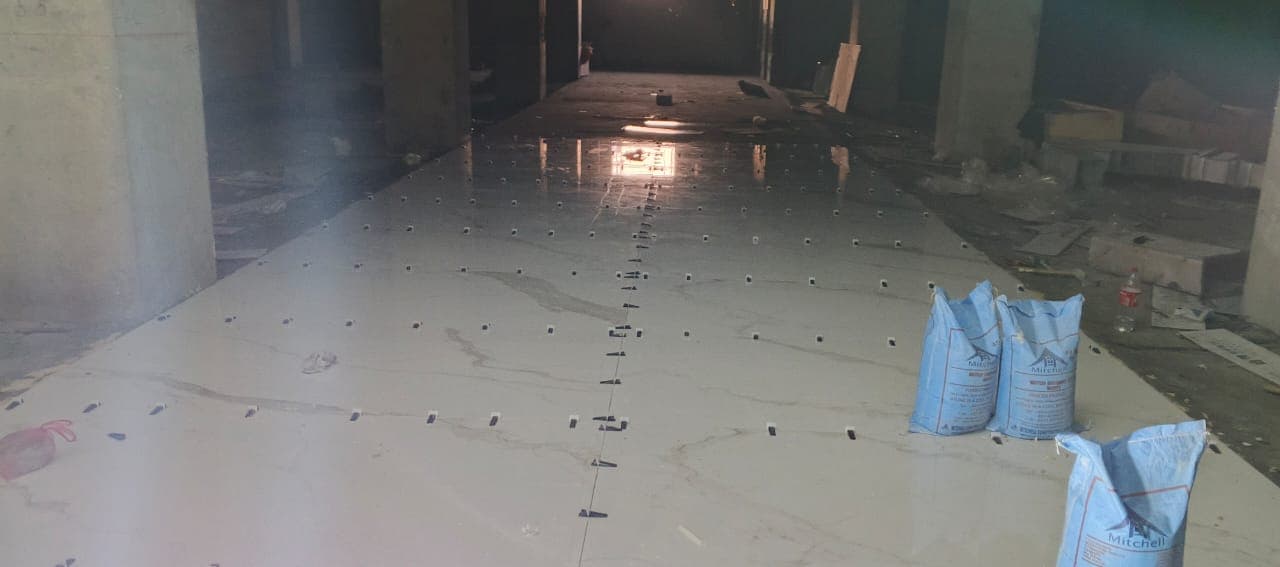
If you have typed "tile fixing rate Islamabad" or "tiles lagwane ka rate" into Google, you want a number. This guide will not give you a single one, and it will explain why any page that does is selling you something. What it will do is show you what moves a quote up or down in Islamabad and Rawalpindi, what a proper quote should include, and how to tell a fair rate from a cheap one that costs you more within a year.
We fix tiles in both cities every week, from a single washroom in Bahria Town to a full 2 kanal house in Askari 10, so everything below comes from quotes we have actually written. For the short version by city — including Lahore and Karachi — see the tile fixing rate in Pakistan page.
Why there is no single tile fixing rate
A tile fixer's labour is priced per square foot, but that figure is the answer to at least five questions:
- What size is the tile? A 2×2 ft (60×60 cm) ceramic tile and a 4×8 ft (120×240 cm) porcelain slab are not the same job. The slab needs a levelled floor, adhesive on both surfaces, a suction lifter, levelling clips on every joint and three or four people to place it. That time and equipment is in the rate.
- What is the floor like? A flat, cured, dust-free screed can be tiled straight away. A floor with a 10 mm dip across a room needs grinding, priming and levelling compound before the first tile goes down. That is a separate line, and it is often the biggest one.
- Is it a wet area? Bathrooms need waterproofing, a flood test, a fall to the drain and usually epoxy grout. None of that applies to a bedroom floor.
- How much cutting is there? Diagonal layouts, rooms with many corners, stairs and niches take longer and waste more tile.
- Is it marble? Natural stone is ground and polished after fixing, which porcelain does not need. That polishing is priced on top.
Two houses on the same street in G-14 with the same tile can have rates that differ by a wide margin because of points 2 and 3 alone. So when someone quotes a rate over the phone without asking those questions, they are quoting the easiest possible version of the job.
Labour-only versus supply-and-fix
The second reason quotes are hard to compare is that "rate" means two different things in Pakistan.
A labour-only rate covers the fixer's work and nothing else. You buy the tile bond (adhesive), grout, skirting tiles and any levelling material yourself, and the fixer tells you what to buy. Most local mistris quote this way.
A supply-and-fix rate includes the adhesive and grout. It looks higher on paper, but you are not running to the market for bags of tile bond halfway through, and the fixer is using the adhesive they actually know how to work with.
When you compare two quotes, make sure they are the same kind. A labour-only rate that looks 30% cheaper than a supply-and-fix rate may not be cheaper at all once you add the materials.
What is almost always priced separately
Even in a supply-and-fix quote, these are normally their own lines:
- Floor levelling — self-levelling compound, priced by area and depth.
- Waterproofing — membrane, primer and tape, priced by area, plus the flood test.
- Epoxy grout — costs several times more than cement grout per kilogram and takes longer to apply and clean.
- Removing old tiles — labour plus disposal.
- Skirting — usually priced per running foot, not per square foot.
- Stairs, steps and niches — priced per piece or per running foot because of the cutting involved.
A quote that lists these as separate items is being honest with you. A quote that leaves them out and then adds them "as found" on site is how a cheap rate becomes an expensive job.
Why specialist large-format fixing costs more than a regular mistri
This is the question we get most often, and it deserves a straight answer.
A regular tile mistri in Rawalpindi has learned on 1×1 ft and 2×2 ft tiles, fixed on cement blobs. That method works for small tiles because the tile is small enough to bridge any gap underneath. It does not work for 2×4 ft or 4×8 ft porcelain. Those tiles are rigid, thin for their size and completely unforgiving of a void underneath: step on a hollow spot and the tile cracks, or it sounds hollow for years and then pops up one summer.
Fixing large-format tiles properly means:
- levelling the floor first, to within a couple of millimetres over the whole room;
- spreading adhesive on the floor and on the back of the tile (back-buttering), so the bed is solid;
- lifting each tile with a suction frame so it goes down flat and is not dropped on a corner;
- clipping every joint with a levelling system until the adhesive cures, so no edge sits proud;
- using a flexible, polymer-modified adhesive that can take the movement of a large tile.
That is a three- or four-person crew moving more slowly and using consumables the mistri does not buy. The rate reflects it. What you get for the difference is a floor that is flat under a raking light, does not sound hollow, and does not need to be lifted and redone. For a 1,500 sq ft living floor in imported porcelain, redoing it costs far more than the difference in the fixing rate.
You can read more about how we handle big tiles on our 2×4 and 4×8 tile fixing page.
What a proper written quote looks like
Here is what we put in every quote, and what you should expect from anyone:
- The measured area of each room, not a number you gave over the phone.
- The tile size and type the rate applies to.
- What is included: fixing, layout, clips, and whether adhesive, grout and skirting are in.
- What is excluded, as separate lines with their own prices: levelling, waterproofing, epoxy grout, tile removal.
- The warranty on the work and what it covers. Ours is a written workmanship warranty covering adhesion, joint integrity and levelling, plus three months of free maintenance after handover.
- Payment stages tied to things you can see finished, such as levelling complete and fixing complete.
If a quote is one line — "tile fixing, Rs X per sq ft" — you do not yet have a quote. You have a starting point for a conversation that will happen on site, when your bargaining position is weakest.
How to get a firm rate for your house
- Measure each room in feet and use the tile calculator to work out your floor area and tile count. Real numbers make the conversation shorter.
- Photograph the floor as it is now, especially any cracks, dips or damp patches.
- Decide your tile size before you ask for a rate. "Big tiles" is not a size.
- Book a site survey. A survey is where flatness, moisture and access get checked, and it is what turns a range into a fixed figure.
In Islamabad our current jobs are in G-14, E-11, Faisal Hills and Askari 10. In Rawalpindi our office is at Safari View Residencia and we cover Bahria Town, Safari and Range Road. If you are in either city, message us on WhatsApp with your area, tile size and rough square footage and we will book the survey. You can also read about our tile fixers in Islamabad and tile fixers in Rawalpindi.
Short answers to the questions people actually search
Tile fixing rate per sq ft in Islamabad? It depends on tile size, floor condition and whether it is a wet area. Get it in writing after a survey.
Is 2×4 tile fixing more expensive? Yes. It needs a levelled floor, back-buttering, suction lifting and levelling clips, and a bigger crew.
Does the rate include tile bond? Only in a supply-and-fix quote. Ask which kind you are being given.
Marble fixing rate? Priced differently from tile because it is ground and polished after fixing.
Cheapest tile fixer in Rawalpindi? The cheapest rate is rarely the cheapest floor. Compare what is included, the warranty and whether the fixer has done your tile size before.